donthatedontkill

- Nantes, France
- June 25, 1986
- Fullstack developer
I am an alien. And I don't really understand what's going on. Sorry.
About three months ago I posted this photo, which was a plan for the Fall 2025 Ango[1][2].
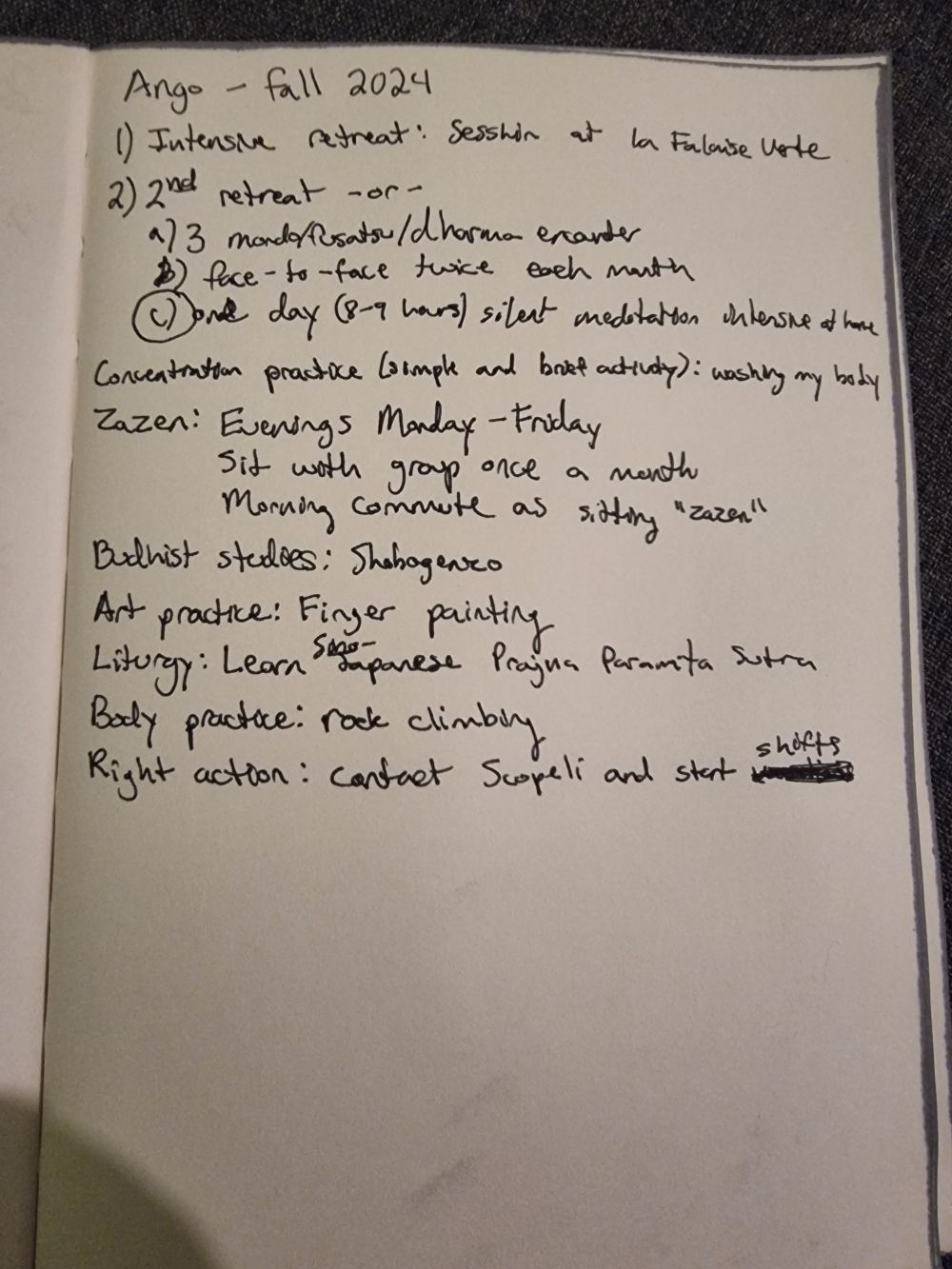
Whenever people post things like this on the internet, it's very easy to imagine that they did exactly that—that it all went perfectly—and when you try to do the same and don't manage to stick to it as much as you'd have liked, to think that there's something lacking in you. So consider this an anti-motivational post of sorts. I wanted to, if only for myself, talk about how these three months went, and keep these lessons in mind for future angos.
I based this ango on a worksheet from the Zen Mountain Monastery, a zen monastery I went to back when I still lived in the US. They have multiple that come up in a simple internet search, and for whatever reason, I chose this one from 2020, which in retrospect, might have been slightly more intense than the other ones I saw. Or maybe this ango just felt more intense. More on that later, I suppose.
First, a few words in general about the context in which this ango happened: The ango was meant to last from the start of September to the end of November, and this ended up being a period where I was traveling (very often abroad) twice a month on average. Had I realized this going in, I would have probably cancelled it, and in retrospect, I wonder if I should have realized midway through that this was not the right time for intensifying my practice. Some people do one ango a year, and I had done the spring one, but I wanted more of that sweet, sweet zazen, so I stuck to it[3]. It was also a somewhat stressful period in my personal life, as I had just moved at the beginning of August, and my two apartments being very different, there was (and still is!) a lot that I needed to put in place. I knew this but said to myself, "No matter! It will make for good samu!"[4] And last but not least importance, I think I am coming to the end of what I have been calling my "Buddhist rumspringa." I converted to Buddhism around fifteen years ago and was instantly drawn to making it the focus of my life and began to toy with the idea of becoming a serious student and maybe even eventually a monk. But I also knew that I wasn't ready to give up what I would need to give up for that. I was young (around 24 years old), and I still had many things I wanted to experience. Now, at almost 40, I think I've come back home, ready to take refuge in the three jewels. If I can find a sangha, that is. Once again, more on that later.
So as you can see, this ango is happening in a context, like they all do. Life doesn't stop just because you decide to dedicate three months to more intense practice. It keeps going. And as a lay Buddhist, you have to contend with that. It is probably one of our biggest challenges as lay practitioners. You may want to meditate for three hours a day, but others in your life need you, you have to work to feed yourself, you have responsibilities to yourself and others that you can't abandon. Attachment to practice can creep in without you noticing. We are always on the look out for attachments to physical objects, to situations, to relationships, but our relationship to our own practice can also become an attachment. So between a full schedule and perhaps a bit too much attachment to practice, I did what I could. So let's look at what I did.
- Sesshin at la Falaise Verte
Last ango, I went to my first sesshin in France, not too far from the city I live in. It was a sesshin for beginners. Though I guess I'm not really a beginner, we're all always beginners over and over. It was also a short, three-day sesshin and that made it easier to commit to with many unknown variables: a group I didn't know, new country, and my first sesshin in many years. I've wanted to write in detail about what happened there for some time, and maybe I will in detail later. But needless to say, it was not the place for me, and so I had decided to venture further away from home and go to the only Rinzai temple in France. At the ZMM, the Zen Buddhism practiced there is a mixture of Rinzai and Soto[5] zen. I had learned some theoretical differences between the two while I was taking a course in Zen during college, but I had not really experienced those difference myself. The previous sesshin was with a Soto group, and I had started to suspect that it was, in part, the Rinzai tradition where I felt more at home, so this sesshin I made the decision to go to the other half of France, where I could experience that four a five day sesshin. Perhaps one day I'll write more extensively about my experiences there, but suffice it to say, the dharma is alive there, and that is the first time I felt that since arriving in France. I will most likely be returning in February for a full week. - One day meditation intensive at home
So this was an interesting experience. I have done solo, at-home halfday intensives, but never a full-day one. I planned a schedule that included zazen[6], kinhin[7], oryoki[8], liturgy, small breaks, trying to remember to the best of my ability how the day had proceeded when I had done full-day intensives back in the US. And it went generally fine, though I wonder if maybe it was about one or two sessions of zazen too much. The last round felt extremely hard and unlike the halfday sits, when I finished, I didn't feel the way I normally do. I felt a bit strung out, for like of a better phrase. It's something I should keep in mind for next time. At la Falaise Verte, we did yaza[9] outside, and it was quite nice, and it's something I'd like to incorporate into the morning half of these half and full day sits. If you can find adequate seating, doing zazen outside is a delight. - Concentration practice: Washing my body
This was a hard one. Basically the idea was to find a simple, short, daily activity and dedicate yourself to doing that action or activity with the utmost concentration. I chose washing my body because it was a daily activity. It seems a natural choice because it's one of the few daily activities I have, and I thought it might help with feeling more connected to my body. I had forgotten one important detail though: my archnemesis, the shower. Like most autistic people, I have some sensory difficulties, and the shower is one of them. The water never seems the right temperature, if it comes out a certain way and hits my skin a certain way it can be anything from annoying to painful (the lighter pressure is normally worse) and the whole experience—the water, the sound, being enclosed—it's just, like, a lot. I can do it, but I do dread it. I realized during this ango that one of the ways I get through this daily experience is by shutting off my mind and going somewhere else. It's also why I'll get "stuck" in the shower. I'm not enjoying it, like I think some people do; I'm just immobilized by the too muchness of it all. So as you can imagine, forcing myself to be more present didn't go well. I gave it an honest try, and it took a while for me to understand all this. Next ango, I'll find something different. - Zazen
I meditated for 35 minutes at a time instead of 20, and it was nice to be able to go a bit deeper. I didn't ever find a local group to hook up with, however. There's one I wanted to go to, but they're only Wednesday evenings, and I never could be free enough to go. They're also on the other side of town. I will make it happen soon though. And my morning commute as a kind of "light" zazen was nice. I noticed things, I heard people talk, I occasionally got lost in my thoughts and then brought myself back to the hear and now. That being said, I will go back to reading on my morning commutes. - Buddhist studies
So there's an error in the photo. What I read was not the Shobogenzo (not really sure I'm ready for that one yet!), but the Shobogenzo zuimonki, which is writings and oral accounts compiled by Koun Ejo, his main disciple. I read it as I do all old texts broken into small parts: I read each part once with the footnotes and everything, reread it again, and then wrote some commentary on that part. The commentary is a bit freefrom. It can be what I understood, what I didn't understand, a way it relates to may day to day life or an experience I had. The point is to process what I read in whatever way seems useful in the moment. I also occasionally pause to read a bit about the historical or theological context. I only made it through Book One, but I'll pick it back up for Book Two next ango. - Art practice
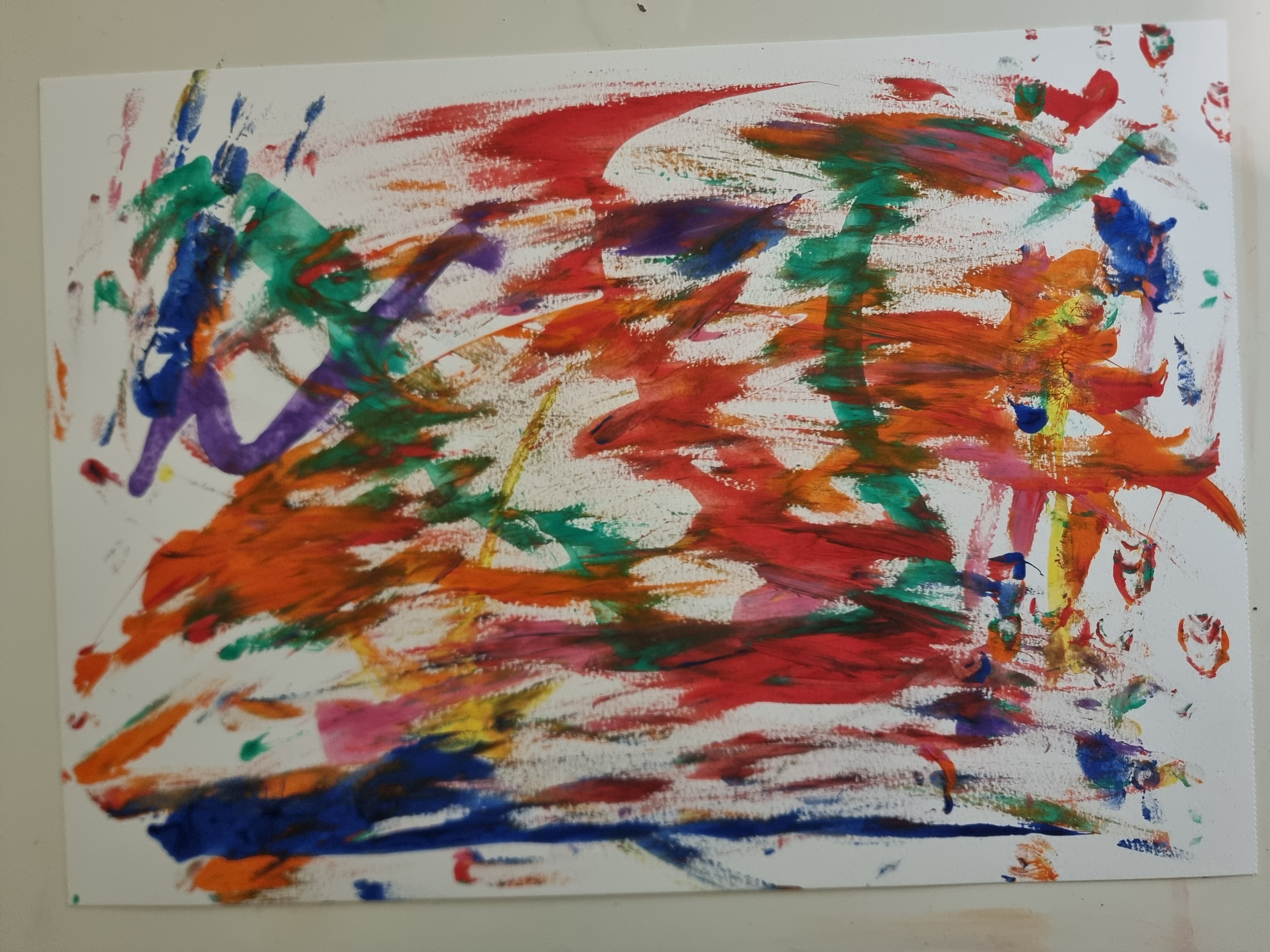
I only got to do this once, sadly, but man, was it an experience! I basically attempted to do hitsuezndo but without a paintbrush, just using my fingers. (Yes! Fingerpainting! ☺️) I let myself move naturally and without intention other than to paint. No attempt to make a beautiful work of art, no without aim or design or pressure, free to just. paint. I chose finger painting because by definition it is not something you expect to turn out good. That being said, I quite like what I made.
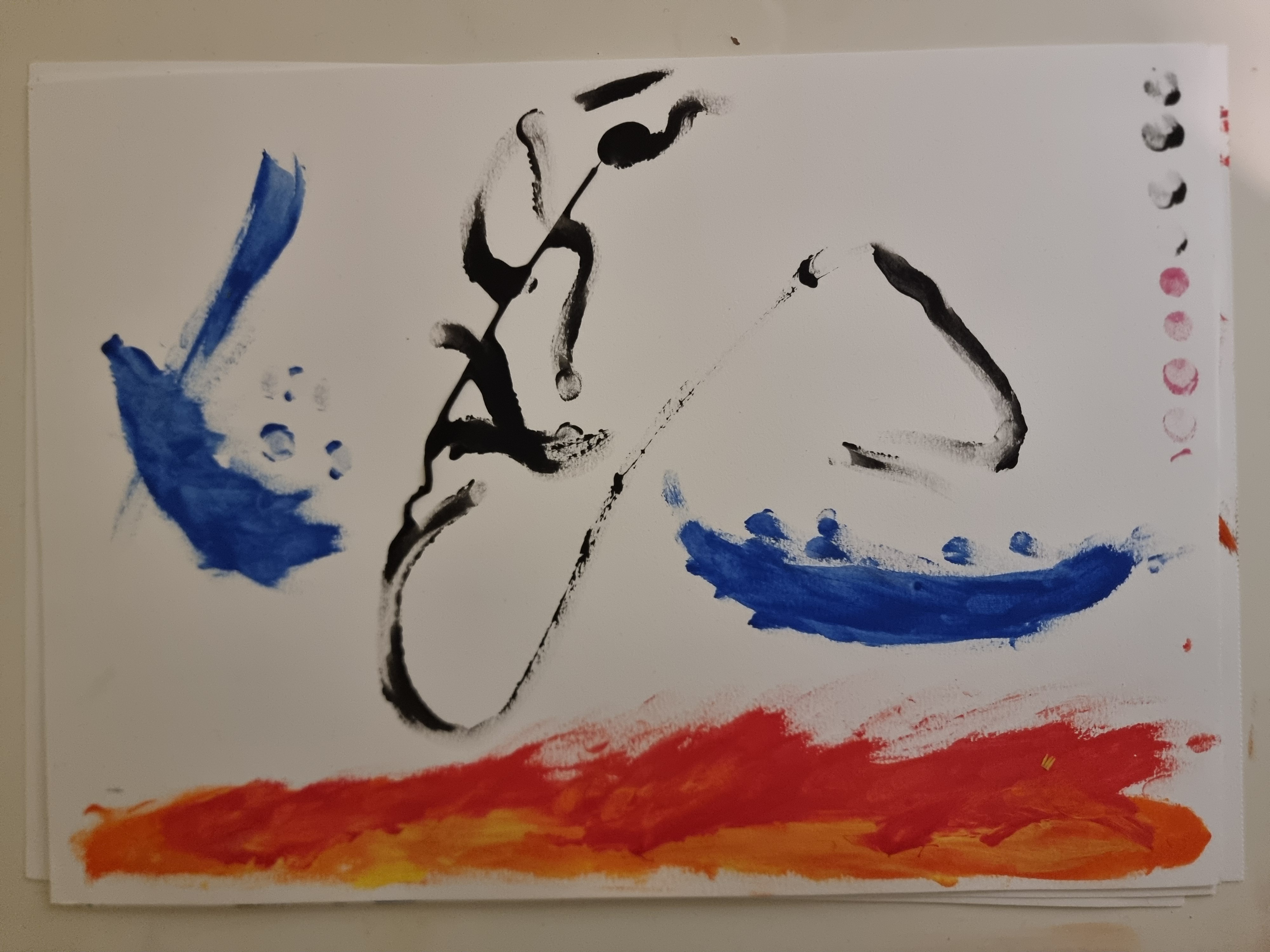
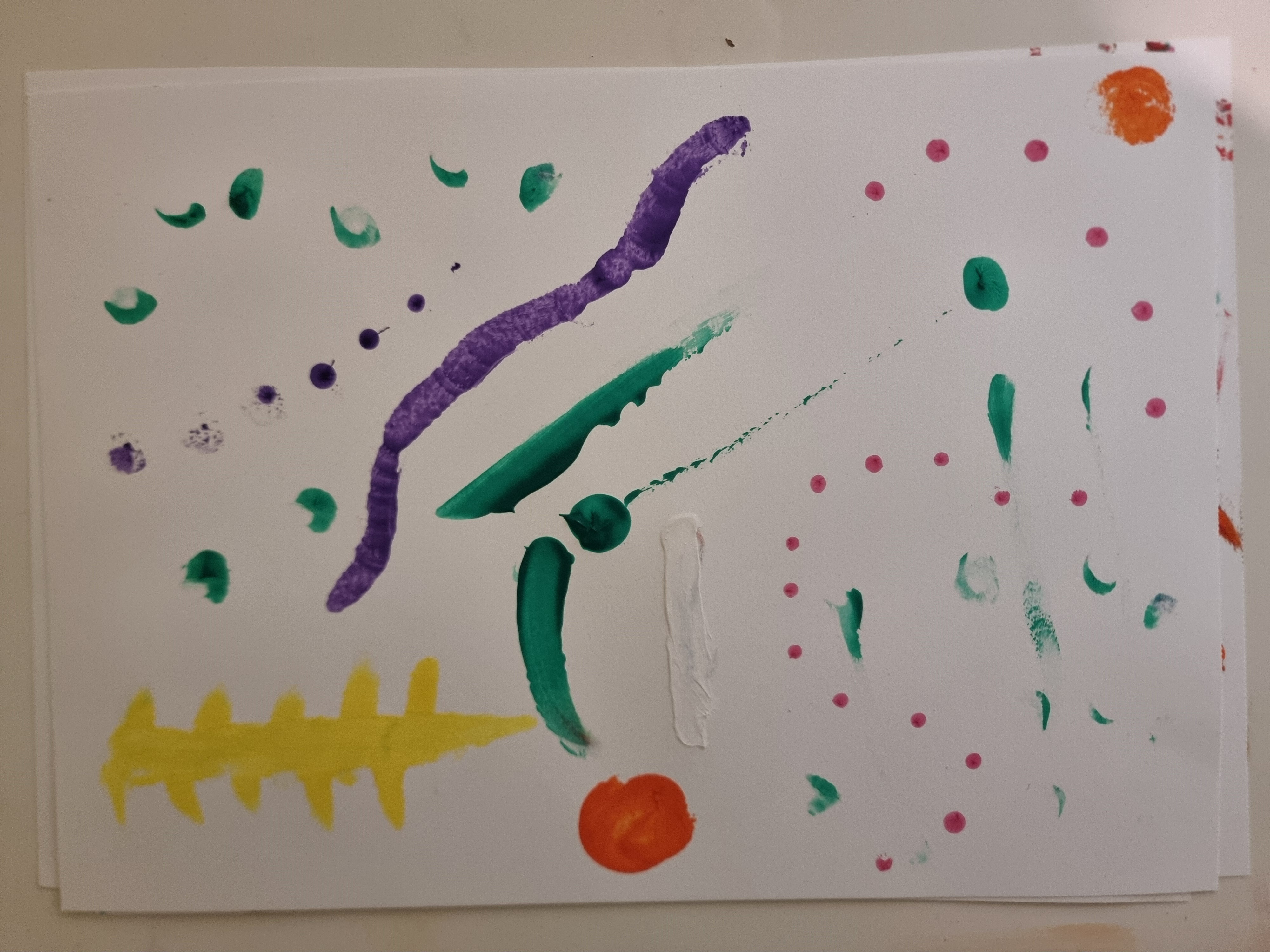
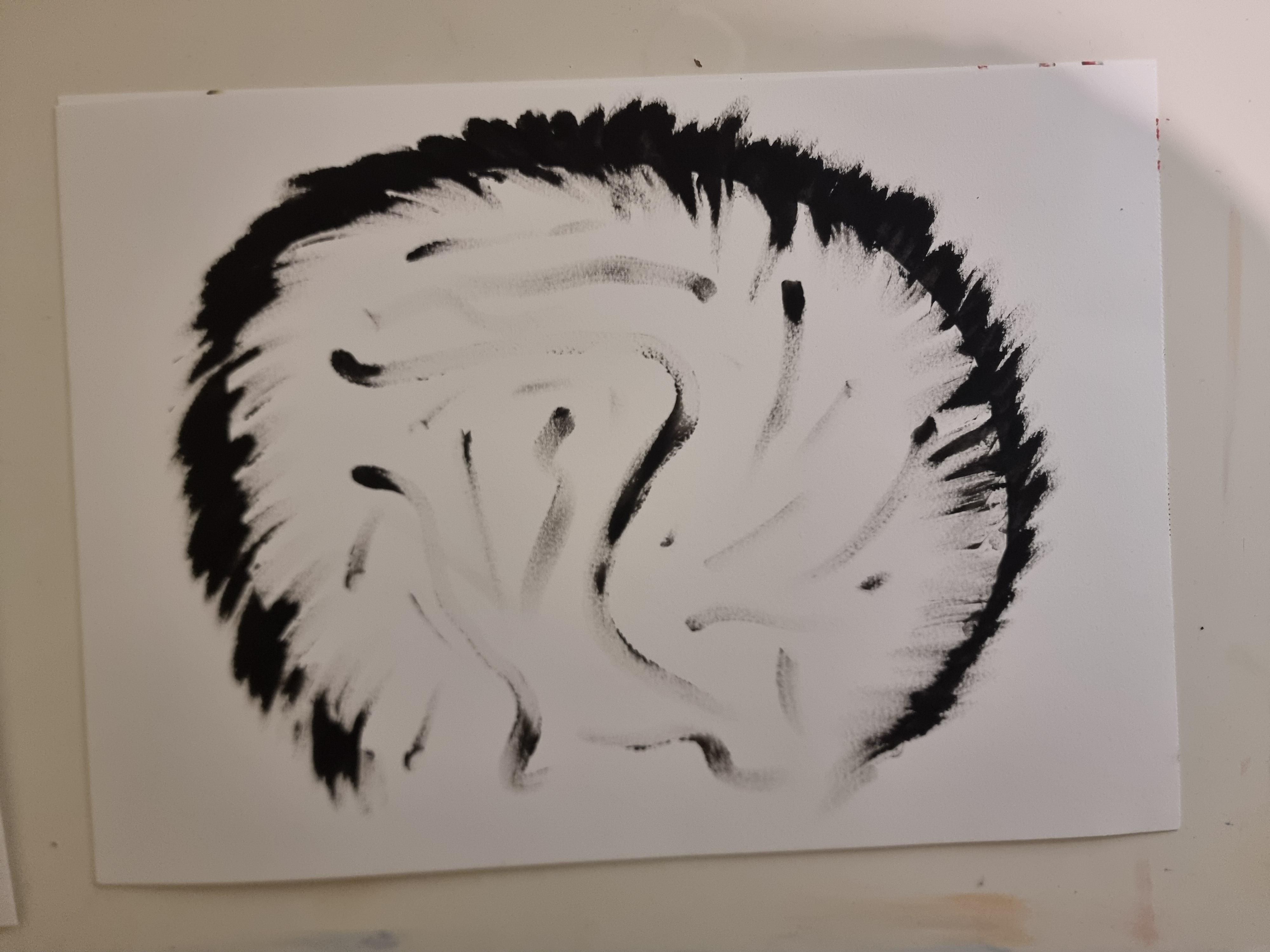
- Learn the Prajna Paramita Sutra[10] in Sino-Japanese
So in France, unlike in the US, most sanghas chant the sutras in Sino-Japanese, not English. I'm not a fan of this. Maybe I'll write something about it one day, but it is the way of things here, and I basically just need to get used to it. So in that spirit, I decided to chant the Heart Sutra in Sino-Japanese. I have to say, it did grow on me, though I still largely prefer to chant in a language I can understand. I think the next step for me is to do a close study of the different characters, the sounds associated with them, and how they translate into a language I understand. I think that will bridge the gap. In any case, it will be an interesting way to analyze it as a text in that way. - Rock climbing as body practice
I didn't get to do this as much as I would have liked, because I basically only could do it if I was in town on a Saturday, but this is excellent body practice, in theory. I already go to the gym and do powerlifting, but I wanted body practice to be something I do that was free of the goals that I put on myself for powerlifting. With rock climbing (bouldering, more specifically), I know I'm not good. I've barely done it. And while getting better would be nice, I'm also fully content to just do it. I don't feel any pressure to be good at it. I think in the future I would like to try to climb more slowly and deliberately, but it's impossible to be outside your body and climb so this was a surprisingly good choice. - Right action: Scopeli
So this didn't happen at all. Basically, Scopeli is a food cooperative here in Nantes, that I had wanted to get involved with to make my food consumption, probably the biggest part of my consumption, more ethical. Basically I was just in town enough. That said, I will none the less contact them soon to get involved. I just need to get a bike first. 😬
And that was my ango. A bit difficult because of the outside obligations but neither a success nor a failure, just what it was.
Next ango I would normally do from March to April, but the full-week sesshin at La Falaise Verte is in February, so I might shift it earlier. But part of me wonders if perhaps it might be good to skip next ango. My life responsibilities are piling up, and it would relieve a good deal mental load to spend time dealing with all of them. I've set many wheels in motion, and now I have to deal with those consequences, wait until the momentum runs out and those wheels stop turning. We all have the fruits of our karma to content with, whether we're in the middle of ango or not, and I should rise to greet mine. But then again, the wheel never stops. It turns and turns. And it we do what we can with what we have. I'll make that decision mid January, until then I'll do what I can with what I have. Gassho.
Ango is a period in Zen Buddhism where you "up your game" for around three months. There is one in fall and one in winter, and they correspond roughly to rainy seasons in India. ↩︎
Yes, I wrote 2024. I think it's early onset dementia. 😅 ↩︎
The ears of some Buddhists will have probably already perked up here in anticipation of a certain problem. ↩︎
Samu is "working meditation." In essence, bringing your full concentration to your work. This is typically more simple and repetitive tasks (peeling vegetables, sweeping, etc.), but really it can be expanded to about anything. ↩︎
These are two of the three main schools of Japanese Zen. The differences between them are subtle and beyond my explaining here. ↩︎
Immobile zen. This is what you most likely picture when you think of zen meditation. ↩︎
Zen in movement. It consists of walking together while in a meditative state. The speed varies between the zen schools. Rinzai tends to be fast and Soto tends to be slow. ↩︎
A ritualized form of eating in zen, designed to keep the same meditative state and for the entire sangha to eat as one. ↩︎
The last session of zazen in the day, of indeterminate length, where you try to push yourself just a little bit further. ↩︎
Also known as the Heart Sutra. An important sutra on the Buddhist concept of emptiness. ↩︎